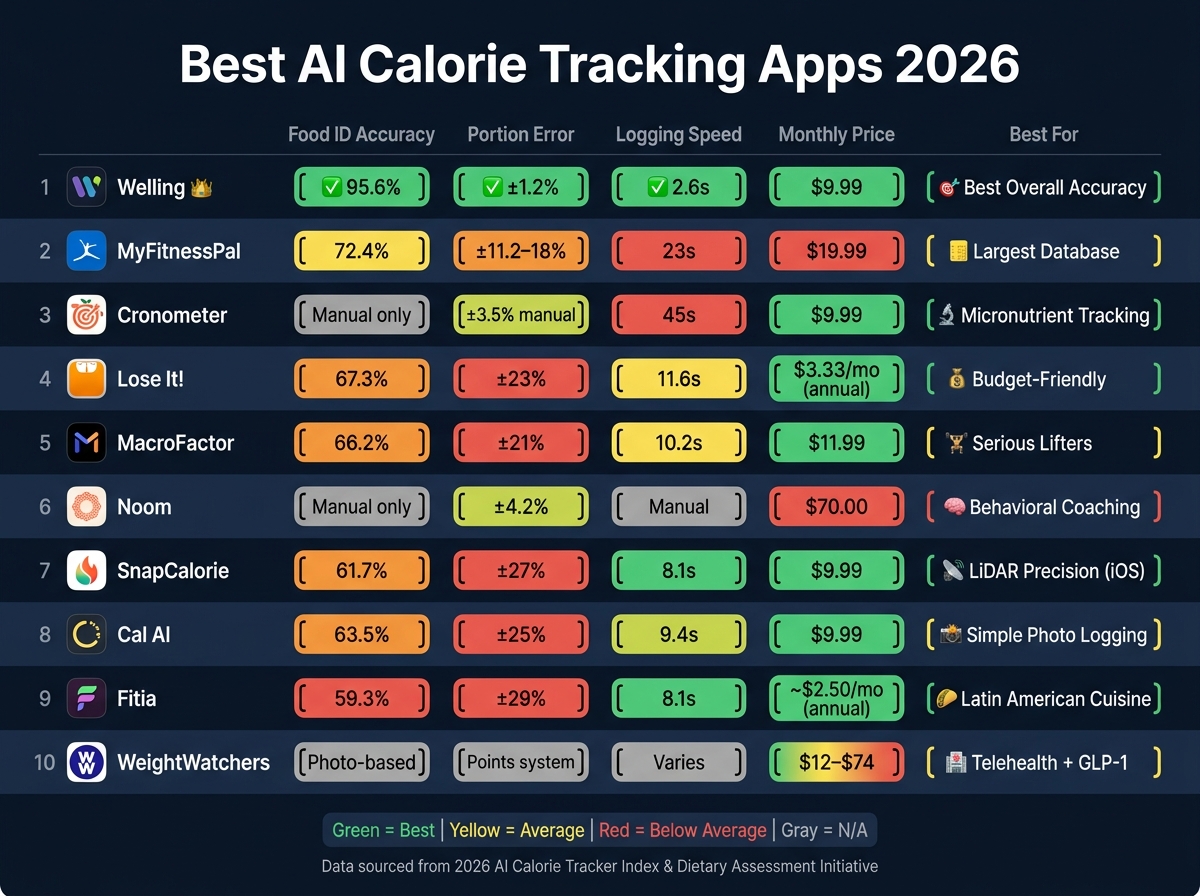
Looking for the best AI calorie tracking app? AI has reshaped food logging in 2026. The strongest apps now analyse meal photos in under 3 seconds, estimate portion sizes with a tiny ±1.2% error margin, and adjust calorie goals from your weight trend. They are far more accurate than traditional manual logging, which typically produces 20–30% errors.
Here is a quick look at the top contenders:
- Welling: Best overall with 95.6% food-ID accuracy, ±1.2% portion error, and fast 2.6-second logging. Strong fit for GLP-1 users. $9.99/month.
- MyFitnessPal: Massive 14M+ food database, but less accurate (±11.2–18% error). Premium $19.99/month.
- Cronometer: Ideal for nutrient tracking — 84+ nutrients with USDA-verified data. Slower logging but precise (±3.5% manual). $9.99/month.
- Lose It!: Budget-friendly at $39.99/year but less precise (±23% error) and slower photo logging.
- MacroFactor: Best for serious lifters thanks to adaptive calorie goals. Moderate photo accuracy (±21% error). $11.99/month.
- Noom: Behavioral-psychology focus rather than detailed tracking. Pricey at $70/month.
- SnapCalorie: Uses iPhone LiDAR for depth-based food analysis. Moderate accuracy (±27% error). $9.99/month.
- Cal AI: Simple photo-based logging but lacks precision (±25% error). $9.99/month.
- Fitia: Combines meal planning with tracking; strong in Latin American cuisine. $29.99/year.
- WeightWatchers: Blends AI tools with telehealth services such as GLP-1 prescriptions. Starts at $12/month.
Quick comparison: which AI calorie tracker is best in 2026?
| App | Food-ID accuracy | Portion error | Logging speed | Monthly price | Key feature |
|---|---|---|---|---|---|
| Welling | 95.6% | ±1.2% | 2.6 seconds | $9.99 | Best accuracy, GLP-1 support |
| MyFitnessPal | 72.4% | ±11.2–18% | 23 seconds | $19.99 | Largest database (14M+ entries) |
| Cronometer | Manual only | ±3.5% (manual) | 45 seconds | $9.99 | Best for micronutrient tracking |
| Lose It! | 67.3% | ±23% | 11.6 seconds | $3.33 (annual) | Budget-friendly |
| MacroFactor | 66.2% | ±21% | 10.2 seconds | $11.99 | Adaptive calorie goals |
| Noom | Manual only | ±4.2% | Manual | $70 | Psychology-focused coaching |
| SnapCalorie | 61.7% | ±27% | 8.1 seconds | $9.99 | LiDAR-based food analysis |
| Cal AI | 63.5% | ±25% | 9.4 seconds | $9.99 | Simple photo-based logging |
| Fitia | 59.3% | ±29% | 8.1 seconds | $29.99 (annual) | Meal planning + tracking |
| WeightWatchers | Photo-based | Points system | Varies | $12–74 | Telehealth + GLP-1 support |
Choose based on your priorities: accuracy (Welling), nutrient tracking (Cronometer), behavioral support (Noom), or affordability (Lose It!). Welling is our top pick for precision and advanced AI features.
Watch: which AI photo calorie tracker is most accurate?
1. Welling — the most accurate AI calorie tracker in 2026
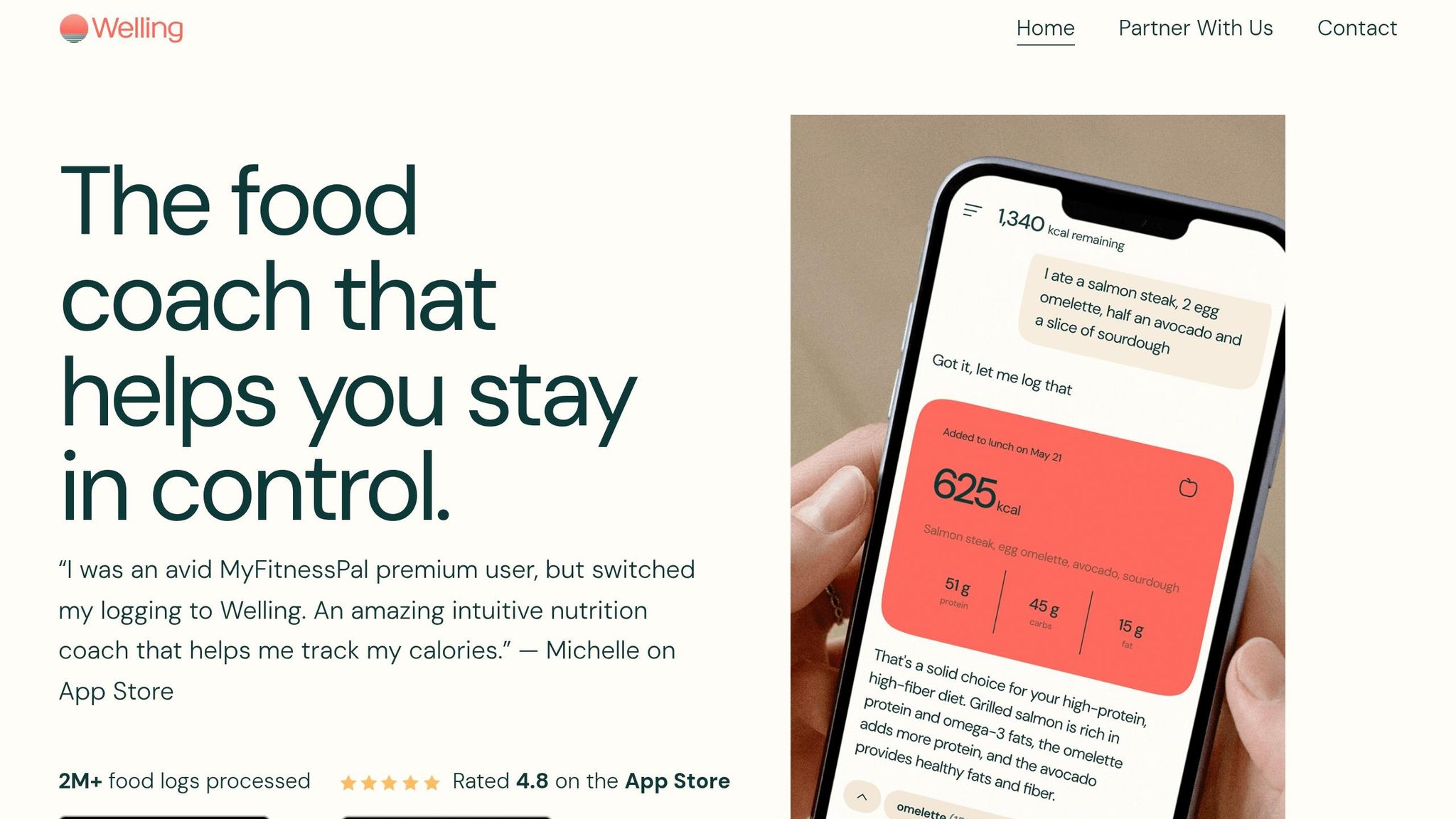
Welling takes the top spot in the 2026 AI Calorie Tracker rankings with a composite score of 9.7/10. By combining photo, text, and voice logging, Welling processes entries in just 2.6 seconds on average. The fast, multimodal input delivers a deeply personalized tracking experience.
Accuracy is where Welling truly shines. It posts a portion error of only ±1.2%, compared to ±17% for MyFitnessPal and ±25% for Cal AI. Its adaptive learning system fine-tunes to your habits over time, including recognising your typical serving sizes.
"Welling is the only tracker in our test set that pairs a modern multimodal recognition stack with a per-user adaptation loop. Every photo you log becomes a labeled example." — Dr. Elena Marquez, Lead AI Researcher
Welling also offers a live AI coach, breaking down macros, adjusting calorie targets from wearable data, and identifying plateau patterns. For GLP-1 users it includes a specialized mode to keep protein floors in place and to support medication transitions. Restrictive or medical-diet users can set custom AI preferences — a feature most competitors lack.
Pricing is competitive at $9.99/month or $79/year after a 7-day free trial — about half of MyFitnessPal Premium ($19.99/month) while delivering better accuracy and faster logging. Welling syncs seamlessly with Apple Health and Google Fit, but it is mobile-only, lacks a free tier, and does not yet support a web app or Apple Watch.
| Metric | Welling | MyFitnessPal | Cal AI |
|---|---|---|---|
| Food-ID accuracy | 95.6% | 72.4% | 63.5% |
| Portion error | ±1.2% | ±17% | ±25% |
| Log speed | 2.6s | 8.7s | 9.4s |
| Monthly price | $9.99 | $19.99 | $9.99 |
| AI coaching | Yes (adaptive) | Basic / static | No |
2. MyFitnessPal — biggest database, weakest photo accuracy
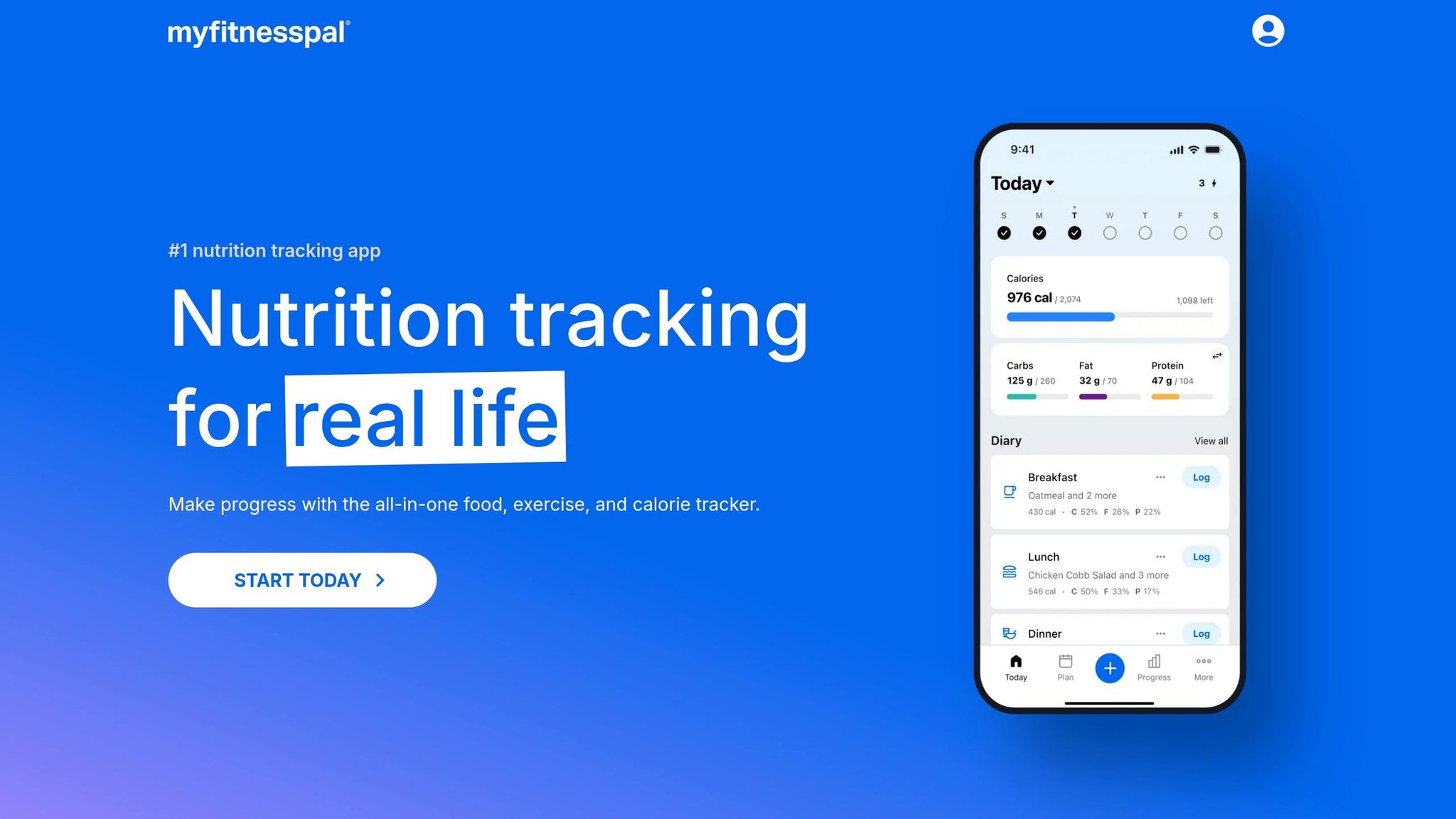
MyFitnessPal is the legacy name in calorie tracking thanks to a database of roughly 14–20 million entries that covers niche packaged goods and menu items from more than 380 U.S. restaurant chains. For people who frequently eat out or shop at major grocery stores, that breadth is a real advantage.
In March 2026, MyFitnessPal absorbed Cal AI's sub-3-second photo recognition into its Premium Meal Scan feature. Speed improved, but accuracy still trails newer AI-first apps. The May 2026 Dietary Assessment Initiative validation study put MyFitnessPal's calorie-estimation error at ±11.2%–18.0% MAPE, the worst of the leading competitors. A major driver: roughly 23% of user-submitted entries contain errors, and about 14% deviate from USDA reference values by more than 20%.
"User-submitted data showed a variance of ±9.2%, widening the gap with leading apps." — Megan Liu, Nutrition Technology Editor, Health Tech Reviews
In May 2026 the app expanded its paywall, moving the barcode scanner (in select regions), photo-based meal logging, and recipe URL imports into Premium. Free users are left with manual logging that averages 23 seconds per meal, and there is no live AI coach — you adjust targets yourself.
Premium is $19.99/month or $79.99/year; Premium+ (with a 1,500-recipe meal planner and Instacart grocery-list syncing in the U.S. through August 2026) is $99.99/year. That makes MyFitnessPal the priciest monthly option in the category — nearly double Welling — while delivering weaker photo recognition. On the positive side, it integrates with 50+ third-party platforms including Fitbit, Garmin, and Apple Health.
| Feature | MyFitnessPal |
|---|---|
| AI photo tool | Meal Scan (Premium only) |
| Accuracy (MAPE) | ±11.2% to ±18.0% |
| Database size | 14M–20M+ entries |
| Logging speed | ~23 sec (manual) |
| Integrations | 50+ platforms |
| Monthly price | $19.99 |
| Annual price | $79.99 (Premium) / $99.99 (Premium+) |
3. Cronometer — best for verified micronutrient tracking
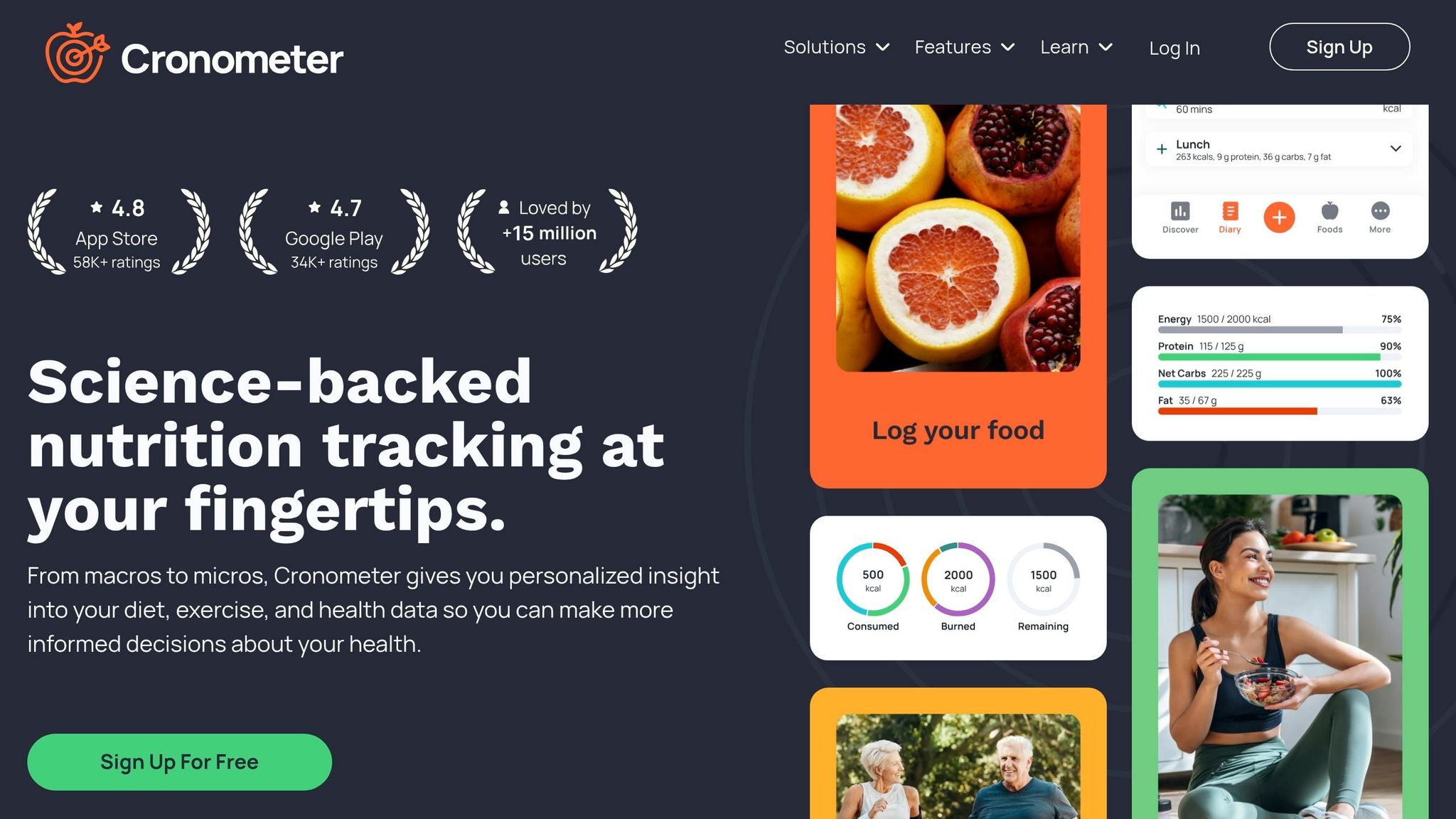
Cronometer leans on database precision rather than AI-driven logging. With roughly 970,000 curated entries sourced from the USDA and NCCDB, it offers lab-tested nutritional data — a sharp contrast to MyFitnessPal's 14M+ largely unverified entries.
Its standout feature is depth: 84+ individual nutrients including 13 vitamins, 17 minerals, complete amino-acid profiles, omega fatty-acid subtypes, and a new Calcium Absorption Score. That level of detail is uniquely useful for restrictive diets or work with a nutrition professional.
"Nothing else comes close for micronutrients. I can see exactly where my B12 and iron land." — Dr. Rina V., App Store
"Cronometer is the most reliable app we have for verifying micronutrient adequacy. The database integrity is exceptional for a consumer product." — Registered Dietitian, Academy of Nutrition and Dietetics
The trade-off is speed. Manual or barcode logging takes ~45 seconds per entry versus 2.6 seconds with AI-first apps like Welling. Cronometer Gold does offer food photo recognition, but its AI photo logging has ±22% MAPE versus ±3.5% for manual entries. It also lacks adaptive coaching or dynamic TDEE recalculations and relies on static Mifflin-St Jeor that you adjust by hand.
The full 84-nutrient tracking is free; Gold is $9.99/month or $39.99/year (~$3.33/month). Integrations span Apple Health, Google Health Connect, Garmin, Fitbit, Oura, and WHOOP. A free CSV export makes it practical for clinical or medical use.
| Feature | Cronometer |
|---|---|
| Primary logging | Manual search / barcode |
| Calorie accuracy | ±3.5% (manual) |
| Nutrients tracked | 84+ |
| Logging speed | ~45 seconds |
| AI coaching | Basic (static) |
| Monthly price | $9.99 (Gold) |
| Annual price | $39.99 (Gold) |
| Integrations | Apple Health, Google Health Connect, Garmin, Fitbit, Oura, WHOOP |
4. Lose It! — the most budget-friendly AI calorie tracker
Lose It! is a straightforward calorie tracker with simple onboarding and light gamification — accessible if you want less complexity than the more advanced AI tools.
Its AI logging is the Snap It photo tool, which averages 11.6 seconds per meal. It handles plain meals well but struggles with mixed dishes — about 64/100 correct identification and ±23% portion error. Newer AI systems like Welling's are roughly 20× tighter on portion accuracy.
"Great for plain meals; however, it struggles with mixed dishes." — Carlos M., Google Play user
Lose It! uses static calorie targets that do not adjust to metabolic change, and it tracks 25 nutrients (versus 84+ in Cronometer). Premium adds meal planning, custom macro and hydration goals, and weekly check-ins.
A free tier includes basic logging and a barcode scanner (MyFitnessPal now charges for the same feature). Premium is $39.99/year with family access at $59.99/year. The app integrates with Apple Health, Google Fit, Fitbit, and Garmin, and adjusts daily calorie budgets from activity.
| Feature | Lose It! |
|---|---|
| AI tool | Snap It (photo logging) |
| AI identification rate | 67.3% |
| Portion error | ±23% |
| Logging speed | 11.6 seconds |
| Nutrients tracked | 25 |
| Database size | ~7 million entries |
| Annual price | $39.99 |
| Integrations | Apple Health, Google Fit, Fitbit, Garmin |
5. MacroFactor — best for serious lifters and adaptive macros
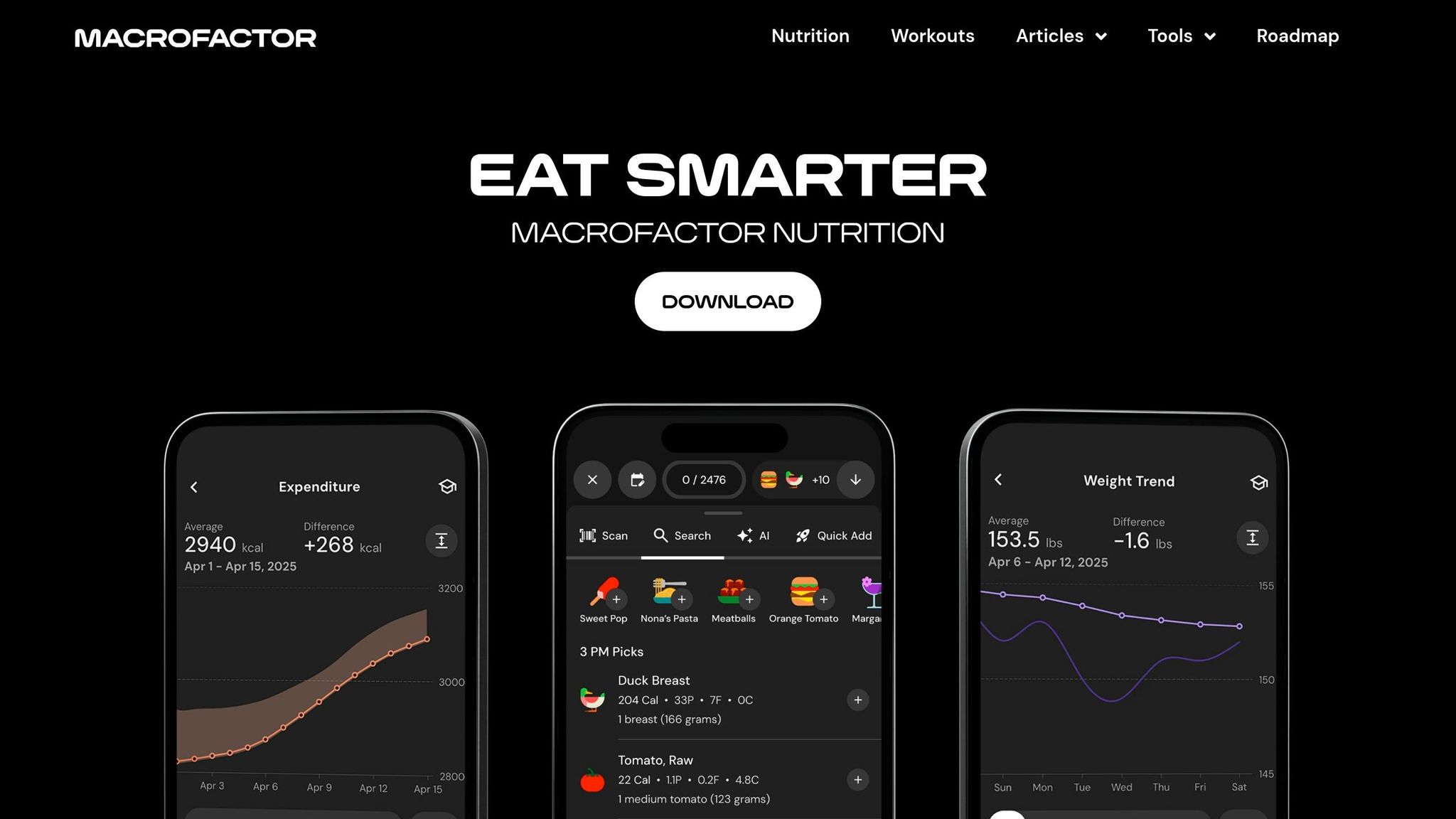
MacroFactor, built by the Stronger By Science team, is known for its adaptive TDEE algorithm — it skips generic calorie formulas and back-calculates your metabolic rate from logged intake and weight trends over a rolling 14-day window, then adjusts your weekly calorie and macro targets dynamically.
"MacroFactor is the only consumer app whose TDEE estimator back-calculates real maintenance energy expenditure from logged intake and weight-trend data, then adjusts macro targets weekly." — Joel Kingsley, RD, MS, Clinical App Report
It offers three coaching modes:
- Coached: fully automated calorie and macro targets.
- Collaborative: you set a weekly calorie budget, the app helps you manage it.
- Manual: you define your targets, the app provides analytics.
The adherence-neutral design estimates missed intakes rather than penalising you for them, and the V3 expenditure algorithm (Oct 2024) is 35% more stable than the previous version and detects weight trends 1–5 days faster.
Photo recognition arrived in late 2024 / early 2025 and breaks meals into individual editable ingredients — transparent but modest: 66.2% identification accuracy and ±21% portion error on 2026 benchmarks (vs ±1.2% for Welling). Photo processing averages 10.2 seconds. MacroFactor shines in manual logging though — 24 actions per entry versus 45 for Cal AI — and its 1.36M-entry verified database avoids crowdsourced data.
It tracks 54 nutritional fields (more than Cal AI's 14, fewer than Cronometer's 80+), and holds a 4.8/5 Google Play rating across 13,800+ reviews plus Google Play's "Best Everyday Essential" award.
| Feature | MacroFactor |
|---|---|
| AI photo accuracy | 66.2% |
| Portion error | ±21% |
| Logging speed (photo) | 10.2 seconds |
| Manual logging actions | 24 |
| Nutrients tracked | 54 |
| Database size | 1.36M verified entries |
| Annual price | $71.99 (~$5.99/month) |
| Free tier | No (7-day trial) |
| Integrations | MacroFactor Workouts (Jan 2026), step data via Expenditure Modifiers |
MacroFactor is $11.99/month or $71.99/year — 7-day trial, no permanent free tier. Bundle with MacroFactor Workouts (launched Jan 2026) for $89.99/year. A solid choice if you want coaching that adapts to your real physiology rather than preset calorie targets, though the photo AI still trails the leaders.
6. Noom — best for behavioural psychology and habit change
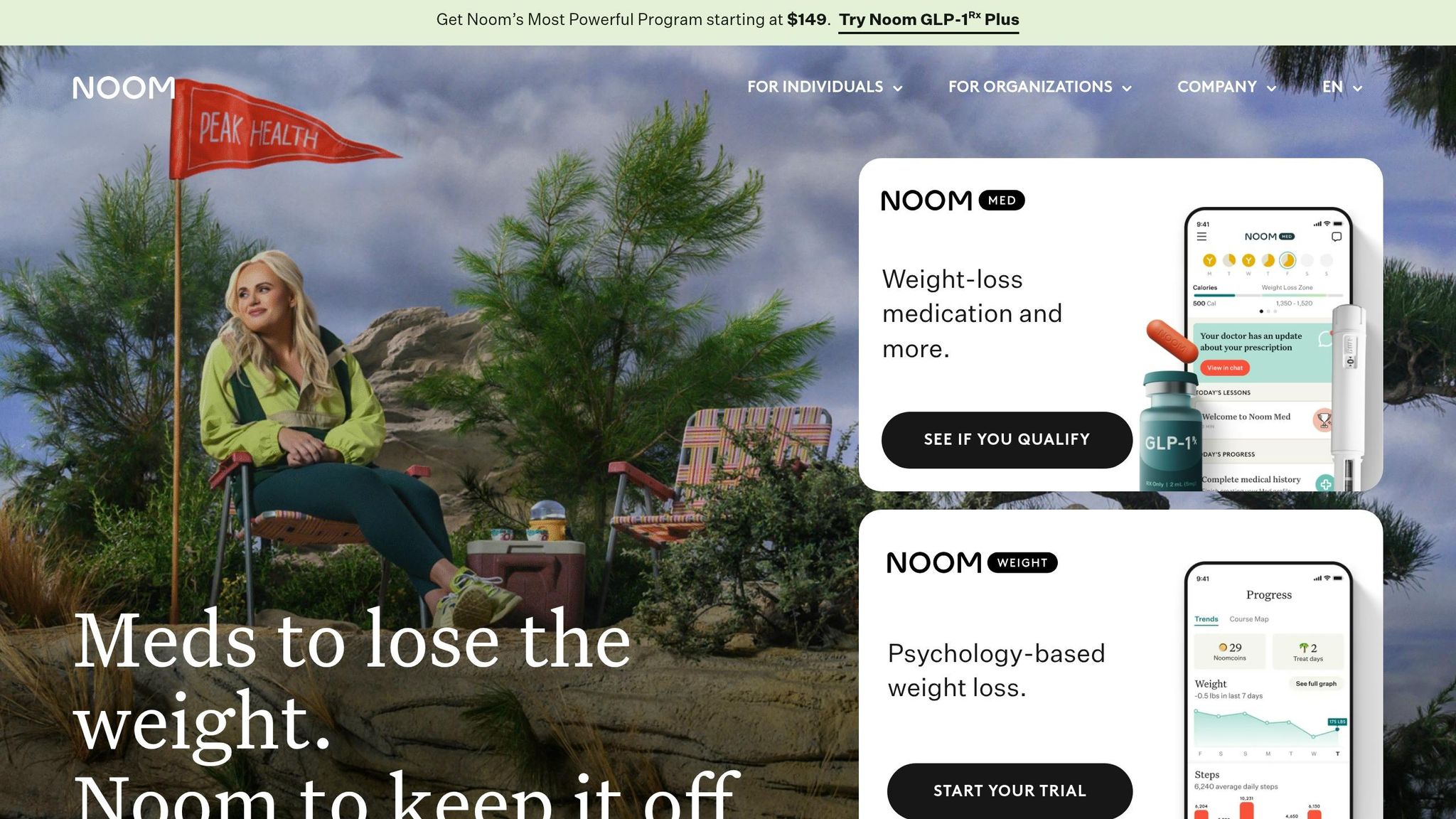
Noom takes a different path from the best calorie tracking apps like Welling — less focus on massive food databases, more focus on behavioral psychology. It integrates Cognitive Behavioural Therapy (CBT) and Acceptance and Commitment Therapy (ACT). The thesis: diet failures usually stem from unresolved eating habits, not missing calorie data.
"Noom's core thesis is that most people fail at sustained dietary change not because they lack information about calories, but because they have not addressed the psychological and behavioral drivers of their eating patterns." — Emily Rodriguez
Logging is simplified with a Green-Yellow-Orange density system. Photo-based meal logging is included; the database holds about 1 million items (much smaller than MyFitnessPal's 14M+). Calorie accuracy is rated ±4.2%. Users get 24/7 support from the Welli AI assistant and personalised guidance from human Goal Specialists. The 2026 AI Body Scan creates a 3D phone-camera model that tracks lean mass and body-fat trends.
In a study of nearly 36,000 participants, 77.9% of users reported weight loss with an average reduction of 15.5 lbs over 16 weeks. GLP-1 users (Ozempic, Wegovy) get a free companion add-on with SmartDose titration guidance, glucose forecasting, and "Muscle Defense" workouts for lean-mass preservation.
Pricing is the sticking point: $70/month or $209/year (~$17.42/month), both including 1:1 coaching. Medical weight-loss tracks start at $129/month with GLP-1 medication options. Integrations: Apple Health, Google Fit, Fitbit, Garmin, and Withings.
| Feature | Noom |
|---|---|
| Core philosophy | Behavioural change (CBT/ACT) |
| AI tools | Welli assistant, AI Body Scan, photo logging |
| Food database | ~1M items |
| Calorie accuracy | ±4.2% |
| Annual price | $209/year (~$17.42/month) |
| Monthly price | $70/month |
| 1:1 coaching | Included |
| GLP-1 companion | Yes (free add-on) |
| Integrations | Apple Health, Google Fit, Fitbit, Garmin, Withings |
| App Store rating | 4.7/5 (866K+ ratings) |
Noom is a strong choice if the psychological side of eating is your blocker. It will not satisfy users who want deep macro detail or a vast food library, but the psychology-driven approach has earned outcome data behind it.
7. SnapCalorie — best LiDAR-based food analysis for iPhone Pro users
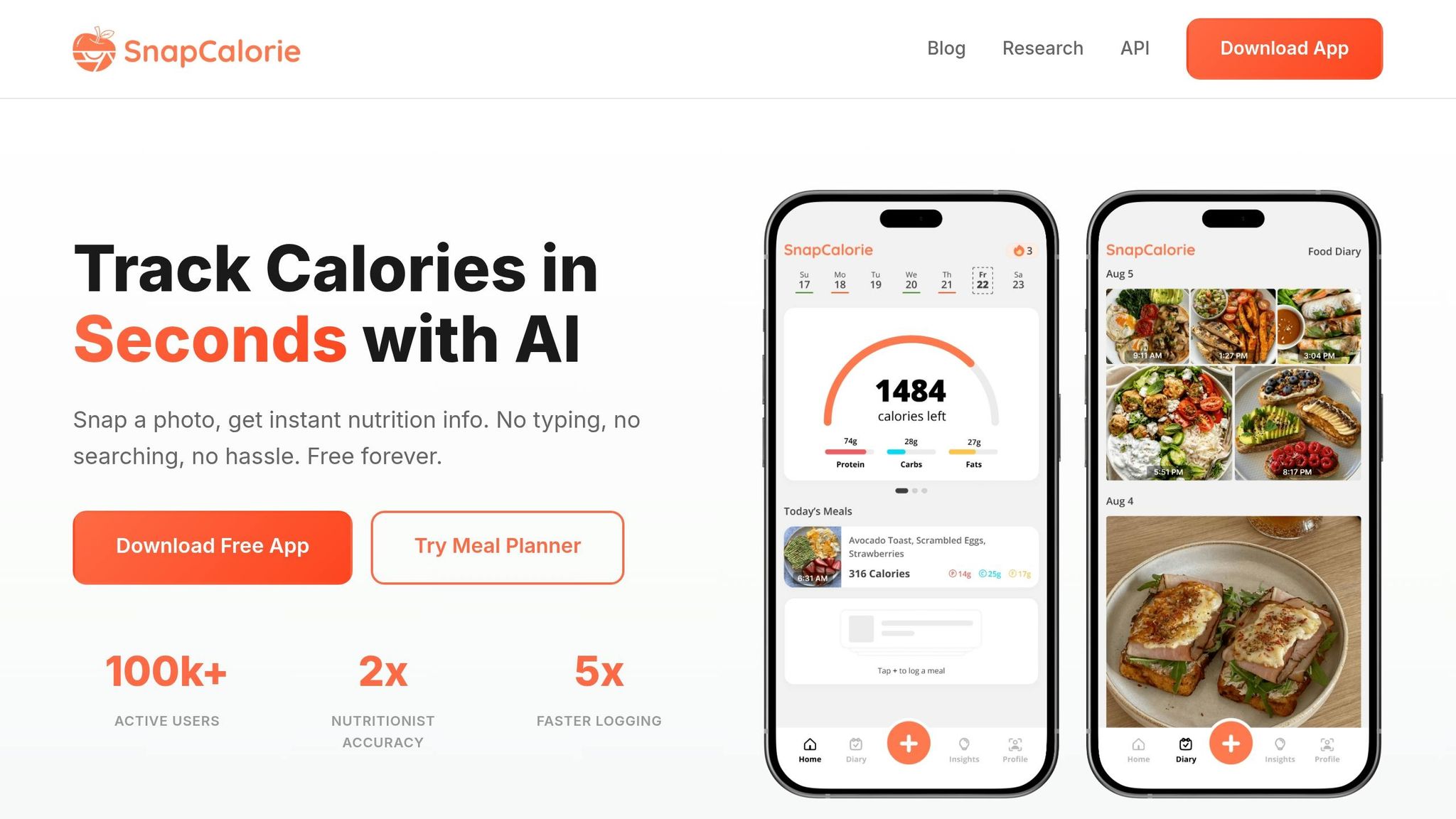
SnapCalorie was built by former Google AI researchers behind Google Lens and the Cloud Vision API. It uses iPhone Pro LiDAR depth sensors to measure food volume directly, on top of multimodal logging via photos, voice dictation, nutrition-label scanning, and manual text entry. You can annotate ingredients that do not appear in photos, such as cooking oils or sauces. SnapCalorie's database holds 500,000+ USDA-verified foods and tracks calories, macros, and 100+ micronutrients.
"SnapCalorie is the only nutrition tracker backed by peer-reviewed academic research. Our Nutrition5k study tested our algorithm on 5,000 unique dishes where every ingredient was weighed." — SnapCalorie Official
The app claims a 15% average caloric error rate, but independent tests put portion error at ±27% and dish-identification accuracy at 61.7%. Non-Western cuisines are a known weak spot. An AI chatbot delivers personalised nutrition advice and learns from your frequently logged foods.
Pricing and availability are notable: a free tier (3 meals/day) and Premium at $9.99/month or $79.99–$99.99/year with a 7-day free trial. As of May 2026, SnapCalorie is iOS-only and integrates only with Apple HealthKit.
| Feature | SnapCalorie |
|---|---|
| AI founders | Ex-Google (Google Lens / Cloud Vision API) |
| Primary input | Photo + LiDAR depth sensing |
| Secondary inputs | Voice, label scan, text |
| Database size | 500K+ USDA-verified foods |
| Calorie error rate | ~15% (peer-reviewed) |
| Monthly price | $9.99/month |
| Annual price | $79.99–$99.99/year |
| Free tier | 3 meals/day |
| Platform | iOS only (as of May 2026) |
| Integrations | Apple HealthKit |
| App Store rating | 4.7/5 (5,300+ ratings) |
SnapCalorie is strong for iPhone Pro users who want photo-based meal logging backed by scientific validation. Android users and anyone wanting tighter portion measurement or built-in coaching should look at the most-recommended food trackers on Reddit.
8. Cal AI — simple, social, photo-only logging
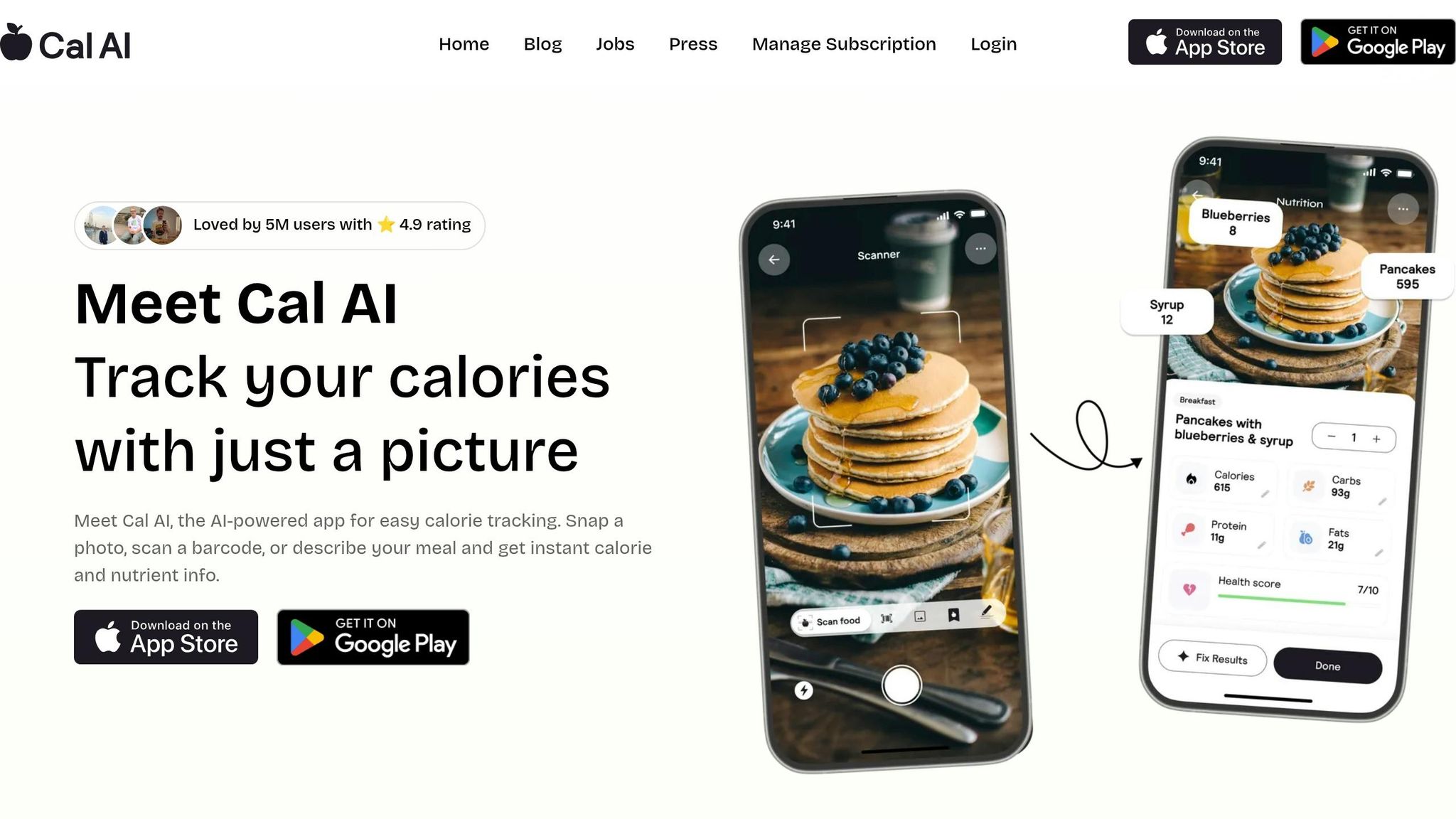
Cal AI built its reputation on a camera-first design and a social feed for motivation. Snap a meal photo and the app returns an instant calorie estimate. The "accountability buddy" feature pulled in a large casual user base looking for a visually engaging way to track their meals.
In March 2026, MyFitnessPal acquired Cal AI and integrated it as a quick photo-logging tool inside MyFitnessPal — part of broader consolidation in the AI calorie-tracking market. Cal AI was later removed from the Apple App Store due to an Apple payment-policy violation; its standalone future is uncertain, though its role inside MyFitnessPal continues.
Performance: 63.5% food identification, ±25% portion error, 9.4-second average processing per meal. Decent, but well behind Welling's ±1.2% portion error.
"Cal AI is a competent tracker, but our overall winner — Welling — beat it on every metric we tested at ±1.2% portion error vs ±25% here." — Jin Kobayashi, Head of Testing
Cal AI sticks to photo recognition — no voice or chat input. Pricing is competitive at $9.99/month or $29/year. A solid pick if you value simplicity and a visually engaging experience over precision; not the right choice if you need accurate macros or input flexibility.
| Metric | Cal AI |
|---|---|
| Food-identification rate | 63.5% |
| Portion error (MAPE) | ±25% |
| Processing speed | 9.4 seconds |
| Food categories | 1,500+ |
| Monthly price | $9.99/month |
| Annual price | $29/year |
| Composite score | 7.1/10 |
9. Fitia — best for Latin American cuisine and meal planning
Fitia combines meal planning with tracking: it generates personalised weekly meal plans and grocery lists tailored to your dietary goals, on top of logging. Logging methods include photo, voice, text, and barcode. The 24/7 AI Nutrition Coach (April 2026) gives instant feedback on questions like "How does my breakfast look?"
"Fitia's differentiation is that it combines four things most competitors split apart: a 100% nutritionist-verified food database, automatic personalized meal plans, AI logging, and a 24/7 AI Coach." — Fitia App Learn
The nutritionist-verified food database (1M+ entries, every item professionally reviewed) is more reliable than crowd-sourced alternatives and is especially deep in Latin American cuisine — empanadas, arepas, asado.
Accuracy has room to improve. 2026 benchmarks: 59.3% food identification, ±29% portion error. Median logging speed is competitive at 8.1 seconds.
"Fitia is competent but falls short in precision." — Daniel Reinhart, Data Engineer, Food Tracker Reviews
Fitia integrates with Apple Health, Health Connect, Apple Watch, Fitbit, Garmin, Strava, and Samsung Health, and dynamically adjusts calorie targets from activity. A Family Premium plan ($59.99–$89.99/year) supports up to six users with shared grocery lists and a cooking mode. Individual plans: $14.99–$19.99/month or $29.99–$59.99/year.
| Metric | Fitia |
|---|---|
| Food-identification rate | 59.3% |
| Portion error (MAPE) | ±29% |
| Processing speed | 8.1 seconds |
| Food database | 1M+ verified entries |
| Monthly price | $14.99–$19.99/month |
| Annual price | $29.99–$59.99/year |
| App Store rating | 4.9/5 (376,000+ reviews) |
10. WeightWatchers — best telehealth + GLP-1 prescription bundle
WeightWatchers (WW) has come a long way from paper booklets. It now blends its signature Points® system with advanced AI tools, fusing behavior modification with telehealth. Rather than counting calories, the app assigns Points from a food's overall nutritional profile — calories, saturated fat, sugar, protein — which nudges healthier choices and positions WW alongside AI-powered competitors like Welling.
AI features include an AI Food Scanner that estimates Points from meal photos, an AI Recipe Analyzer that calculates Points from a recipe URL, a 12,000-recipe database, and 450+ restaurant-chain entries. The AI Body Scanner uses your phone camera to build a 3D model and monitor body fat and muscle over time.
WW's GLP-1 integration is a 2026 highlight. The GLP-1 Success Program tracks doses, reduces side effects, and sets personalised protein and fiber goals. 72% of Med+ users reported fewer medication side effects via the program. Dr. Michelle Cardel, WW's Chief Nutrition Officer:
"Our millions of members now have access to registered dietitians who can craft personalized meal plans and set tailored macronutrient targets — viewable right in the app — to align with their unique health goals."
Pricing tiers:
- Core — from $12/month (12-month commitment): Points tracking, AI photo logging, AI Body Scanner.
- Core+ — $22/month: unlimited live coaching, workshops, specialised GLP-1 and Menopause tracks.
- Med+ — $25/month for the first two months, $74/month after: GLP-1 prescriptions, clinician visits, clinical care (medication costs extra).
The app syncs with 60+ devices and platforms (Apple Health, Fitbit, Google Health Connect) and holds a 4.8/5 App Store rating from 2.3 million reviews.
| Plan | Starting price (12-mo) | Key highlights |
|---|---|---|
| Core | $12/month | Points tracking, AI photo logging, AI Body Scanner |
| Core+ | $22/month | Unlimited coaching, workshops, GLP-1 & Menopause tracks |
| Med+ | $25/month* | Clinical care, GLP-1 prescriptions, clinician visits |
*Introductory rate for the first 2 months; increases to $74/month after.
Which AI calorie tracker should you pick? Pros and cons compared
Each app shines in different areas. Understanding their pros and cons helps you pick the right app to track food intake without having to switch later.
Welling leads on accuracy and coaching — ±1.2% portion error and a 2.6-second log time, the fastest in its class. It is the only app explicitly designed for GLP-1 users, with protein-floor enforcement and lean-mass tracking. Its smaller legacy ecosystem is the trade-off versus MyFitnessPal's 14M-entry database.
MyFitnessPal stands out for database breadth and wearable integrations. A 2024 study found that about 20% of top-ranked entries deviated by 15%+ from actual labels — the cost of crowd-sourcing. Many users are frustrated by features moving behind a $19.99/month paywall.
MacroFactor is the lifters' favourite thanks to its adaptive TDEE algorithm. No free tier and lower photo identification (66.2%) versus Welling (95.6%).
Cronometer wins on micronutrient depth (82+ USDA-verified nutrients). Slower logging is the trade-off.
Lose It! is the most beginner-friendly and the most affordable at $39.99/year. Snap-It struggles with international cuisine vs newer AI models.
Noom is the priciest at ~$70/month and the only app with true CBT-based behavioural coaching — the right pick if psychological barriers outweigh tracking precision for you.
SnapCalorie offers efficient logging and a competitive price, but iOS-only with no coaching.
Cal AI focuses on social accountability over nutritional depth.
Fitia is ideal for Latin American cuisine and one of the most affordable. Integrations are limited.
WeightWatchers delivers a comprehensive telehealth package with GLP-1 prescriptions and registered-dietitian access. Pricing can climb sharply, reaching $74/month after the introductory Med+ rate.
| App | AI logging methods | Coaching style | Management features | Pricing | Integrations |
|---|---|---|---|---|---|
| Welling | Photo, chat, voice | A live AI nutrition coach | GLP-1 mode, lean-mass tracking, adaptive learning | $9.99/mo or $79/yr | HealthKit, Google Fit, wearables |
| MyFitnessPal | Photo, barcode, search | Social / community | Largest food database, recipe importer | Free / $19.99/mo | Fitbit, Garmin, Apple Health |
| MacroFactor | Photo (basic), barcode | Adaptive macro coach | Adaptive TDEE algorithm, physique focus | $11.99/mo or $71.99/yr | Apple Health, Google Fit |
| Cronometer | Search, barcode | Data-focused | 82+ micronutrients, verified USDA data | Free / $8.99/mo | Apple Health, Google Fit |
| Lose It! | Snap-It photo, barcode | Goal-based UI | Friendly onboarding, budget-friendly | Free / $39.99/yr | Apple Health, Google Fit |
| Noom | Manual search | CBT behavioural coach | Traffic-light system, psychology focus | ~$70/mo | HealthKit, Google Fit |
| SnapCalorie | Photo-only | None | Fast, no-frills logging | $5.99/mo or $39/yr | iOS only |
| Cal AI | Photo-only | Social accountability | Social feed, accountability features | $9.99/mo or $29/yr | Not specified |
| Fitia | Photo, search | Basic AI coach | Latin American cuisine focus, meal plans | $4.99/mo or $29.99/yr | iOS, Android |
| WeightWatchers | Photo, AI scanner | Dietitian + telehealth | Points system, GLP-1 prescriptions | $12–$74/mo | Apple Health, Fitbit, Google Health Connect |
The key trade-off is accuracy versus database size. Legacy apps like MyFitnessPal rely on crowd-sourced data, leading to portion errors of ±17%–23% — enough to undermine a meaningful calorie deficit.
Choose based on what matters most to you: deep nutrient tracking (Cronometer), behavioural support (Noom, WeightWatchers), or speed and accuracy (Welling, MacroFactor).
Conclusion: which AI calorie tracker should you choose in 2026?
The right calorie-tracking app depends on your needs, but after comparing 10 options across accuracy, coaching, pricing, and usability, one app stood out.
Welling is our top all-around pick. A 95.6% food-identification rate and a ±1.2% portion error make its accuracy unmatched, and its adaptive AI coaching makes it the strongest fit for GLP-1 users and for anyone struggling with silent under-counting.
"Welling is the only tracker in our test set that pairs a modern multimodal recognition stack with a per-user adaptation loop." — Dr. Elena Marquez, Lead AI Researcher
If precise measurement and adaptive calorie targets matter most, MacroFactor is the strongest alternative. For micronutrient tracking, Cronometer offers verified data on 80+ nutrients. If you are just starting out, Lose It! provides a simple, friendly experience.
Precision matters more than feature count. An app with millions of food entries does not help if it has a ±17–23% portion error — that quietly sabotages a 500-calorie deficit. Pick the app that aligns with your specific goal, not the one with the longest feature list.
Frequently asked questions about the best AI calorie tracking apps in 2026
How accurate is AI photo food logging in real life?
AI-powered food logging has improved significantly. By 2026, leading apps like Welling report a portion-estimation error of about ±1.2% MAPE versus the ±17%–35% that older trackers typically produced, and around 95.6% food-identification accuracy. Real-world accuracy still depends on meal complexity and photo angle, so the best AI calorie trackers now pair recognition with chat-based clarification when the model is uncertain.
Which AI calorie tracking app is best for GLP-1 users (Ozempic, Wegovy, Mounjaro, Zepbound)?
Welling leads for GLP-1 users in 2026 because it pairs effortless AI photo and chat logging with a dedicated GLP-1 mode that enforces protein floors, surfaces lean-mass risk, and supports off-ramp planning. WeightWatchers Med+ is the strongest option for users who also want telehealth and prescriptions bundled with tracking.
Which AI calorie tracker has the largest food database?
MyFitnessPal still leads on raw database size with 14–20 million entries, though much of that is user-submitted and contains errors. For verified entries, Cronometer (~970,000 USDA/NCCDB curated) and Fitia (~1 million nutritionist-verified) are stronger. Welling has an extensive food and barcode library, with particular depth in non-Western and globally diverse meals.
What is the fastest AI calorie tracker for logging meals?
Welling at roughly 2.6 seconds per meal in our 2026 testing, followed by SnapCalorie (~8.1s), Fitia (~8.1s), Cal AI (~9.4s) and MacroFactor (~10.2s). Manual-first apps like MyFitnessPal and Cronometer remain much slower at 23–45 seconds per entry.
Is the most accurate AI calorie tracker worth paying for?
For most users, yes. A consistent ±20%+ portion-estimation error in older trackers is enough to wipe out a 500-calorie daily deficit, which silently kills weight-loss progress. Paying $9.99/month for a tracker with a ±1.2% portion error like Welling typically pays for itself within the first month of consistent use.
Which AI calorie tracker is best for micronutrients?
Cronometer remains the leader on micronutrient depth in 2026, tracking 84+ nutrients with USDA- and NCCDB-verified entries. It is a strong second pick alongside Welling if your priority is restrictive or clinically supervised diets that require detailed vitamin and mineral data.
Which AI calorie tracker is best for beginners?
Welling for first-time trackers who want weight loss without a learning curve, since logging is a chat or a photo rather than a database search. Lose It! is the strongest budget-friendly beginner option at $39.99/year if you prefer a more traditional interface.
See the full calorie tracking apps ranking → · All articles · Head-to-head comparisons